
Scottsdale, Arizona

Bipolar disorder treatment built around stability.

The highs cost something. So do the lows, and so does bracing for the next one.
Bipolar disorder treatment at our Scottsdale practice is outpatient psychiatric care built around one aim: a life that holds steady.
That means careful, minimal medication with close attention to mood, and a real look at the history you bring with you.
Careful, minimal medication
Close attention to mood stability
Psychiatrist and psychiatric NP
Adults 18+

Who we see

When medication has been the whole conversation

Most people who find us have already tried something.
A medication that worked for a while, then stopped. Appointments that covered dosage and very little else.
Some also carry trauma that has never been part of their psychiatric care at all, even though it shapes how stress lands and how mood moves.
Most people with bipolar have been treated as a diagnosis.
Here you’re treated as a person with a history.
Care looks at
Mood stability
Medication history
Sleep
Nutrition
Trauma history

Our approach

Trauma-informed psychiatry for bipolar disorder

We take both the biological and the trauma-related contributions to bipolar disorder seriously. Neither one cancels the other out, and good care doesn’t have to choose.
A symptom carries information about what your system needed at the time it learned to respond that way, and we would rather understand it than suppress it.
Most places
Two offices
A prescriber for the medication, a therapist for everything else, and the two rarely compare notes.
Here
One conversation
Psychiatry and trauma work sit inside one practice, held by a team trained across both, so the medication and the history behind it are looked at together.
We don’t treat a diagnosis as a fixed label.

Medication

A bipolar psychiatrist who uses medication carefully

Our approach is careful, minimal medication with close attention to mood stability. Medication can steady mood and create enough room for deeper work to become possible.

We use it as a supportive tool, start at the smallest amount that genuinely helps, and review it against how you’re actually doing. We support careful tapering when coming off a medication is the right call.
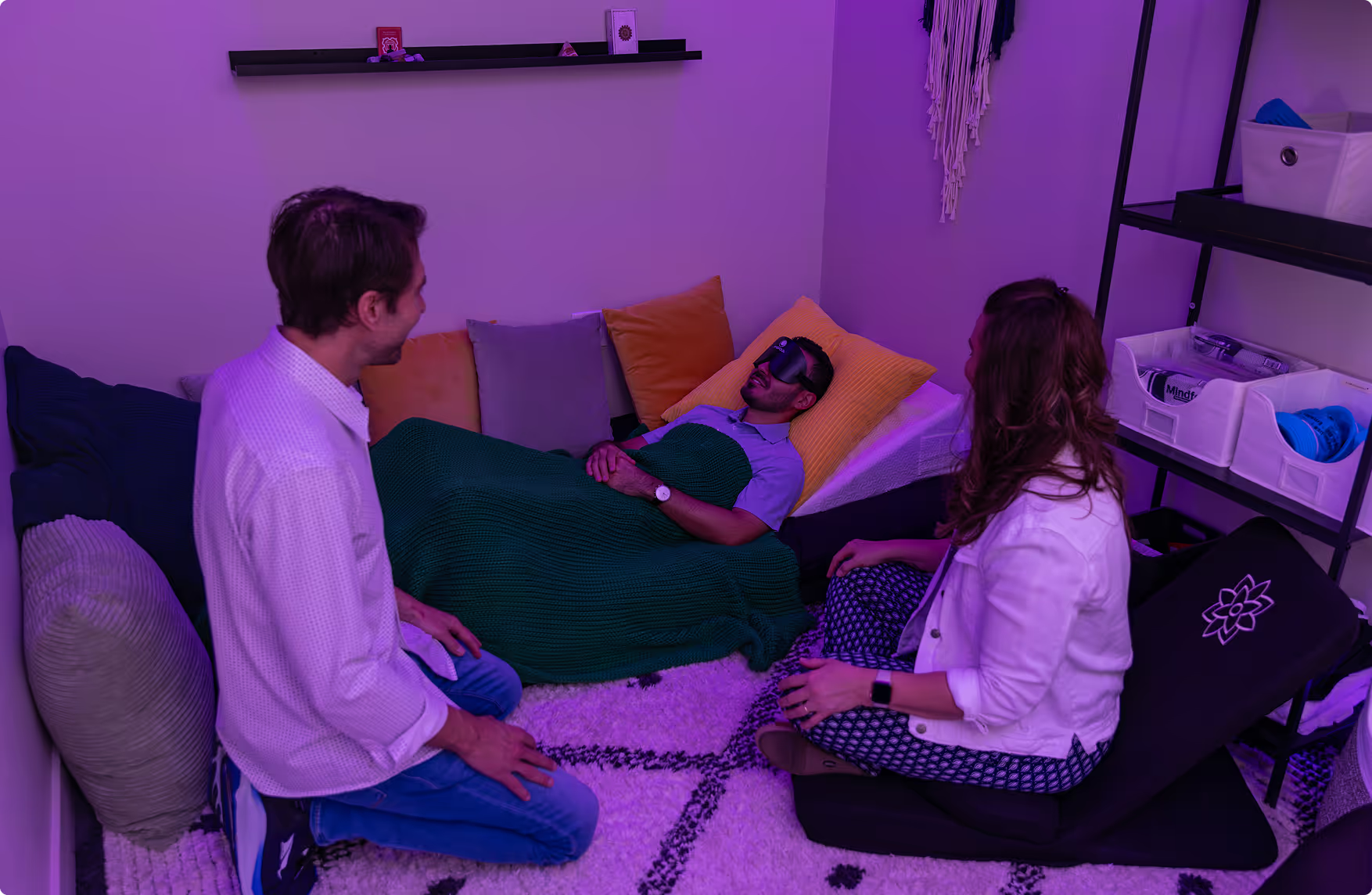
Medication matters in bipolar disorder. So does everything it doesn’t reach.
Man lying on a couch covered with a green blanket and wearing an eye mask, while two people sit nearby in a cozy room with purple lighting.

What to expect

What outpatient bipolar treatment involves

Psychiatric evaluation
Care begins with a full psychiatric evaluation. We review your current concerns, your medical and psychiatric history, what you have already tried, and what did or did not help.
We also look at
  • Sleep
  • Nutrition
  • The stress you carry now, and the experiences that taught your system to respond this way
  • Every medication tried so far, and how each one ended
Medication changes, made with you
If you take medication for bipolar disorder now, please don’t stop or change it on your own.
Any change is made carefully and with you, watching mood closely.
Outpatient care
We provide outpatient psychiatric care for bipolar disorder.
We don’t provide emergency or inpatient services.

Questions

What people ask about bipolar treatment

If something you need to know isn’t here, call and ask. We would rather answer it now than have you wonder.

Is this outpatient bipolar treatment?

Yes. We provide outpatient psychiatric care for bipolar disorder. We don't provide emergency or inpatient services, so if you're in a crisis or an acute episode, call the Arizona Crisis Hotline at 1-844-534-4673, dial 911, or go to your nearest emergency room.

Will you take me off my medication?

Only if it's the right clinical call. Any change to bipolar medication is a careful clinical decision made with you, with close attention to mood stability. Please don't stop or change a medication on your own.

Do you treat bipolar disorder and trauma together?

Yes. We take both the biological and the trauma-related contributions to bipolar disorder seriously, and our psychiatric care is trauma-informed from the first evaluation.

Do you offer ketamine-assisted psychotherapy for bipolar disorder?

Our care for bipolar disorder is psychiatric: evaluation and careful medication management. Ketamine-assisted psychotherapy at our practice focuses on other conditions, such as PTSD, treatment-resistant depression and anxiety.

Do you see children or teenagers?

No. We work with individuals 18 and older.

Reach out

Wherever you are in this, a conversation is a reasonable place to start.
To ask a question or book an evaluation, call us. You can also email info@traumahealingjourneys.com.
Call Us (602) 842-9919
We do not provide emergency psychiatric services. If you are in crisis, call the Arizona Crisis Hotline at 1-844-534-4673, dial 911, or go to your nearest emergency room.