There are moments in our lives that don’t announce themselves as turning points. They rarely arrive with certainty or dramatic clarity. More often they begin quietly, with a question, an invitation, or a longing we can’t quite name.
For me, one of those moments began with a flight to Colombia.As one of the founders of Trauma Healing Journeys, I spend much of my life walking alongside others as they navigate trauma, grief, relationships, and the deeply personal work of healing. It’s work I cherish. But I’ve come to believe that those of us who devote our lives to holding space for others also need opportunities to step away from our roles and reconnect with ourselves.
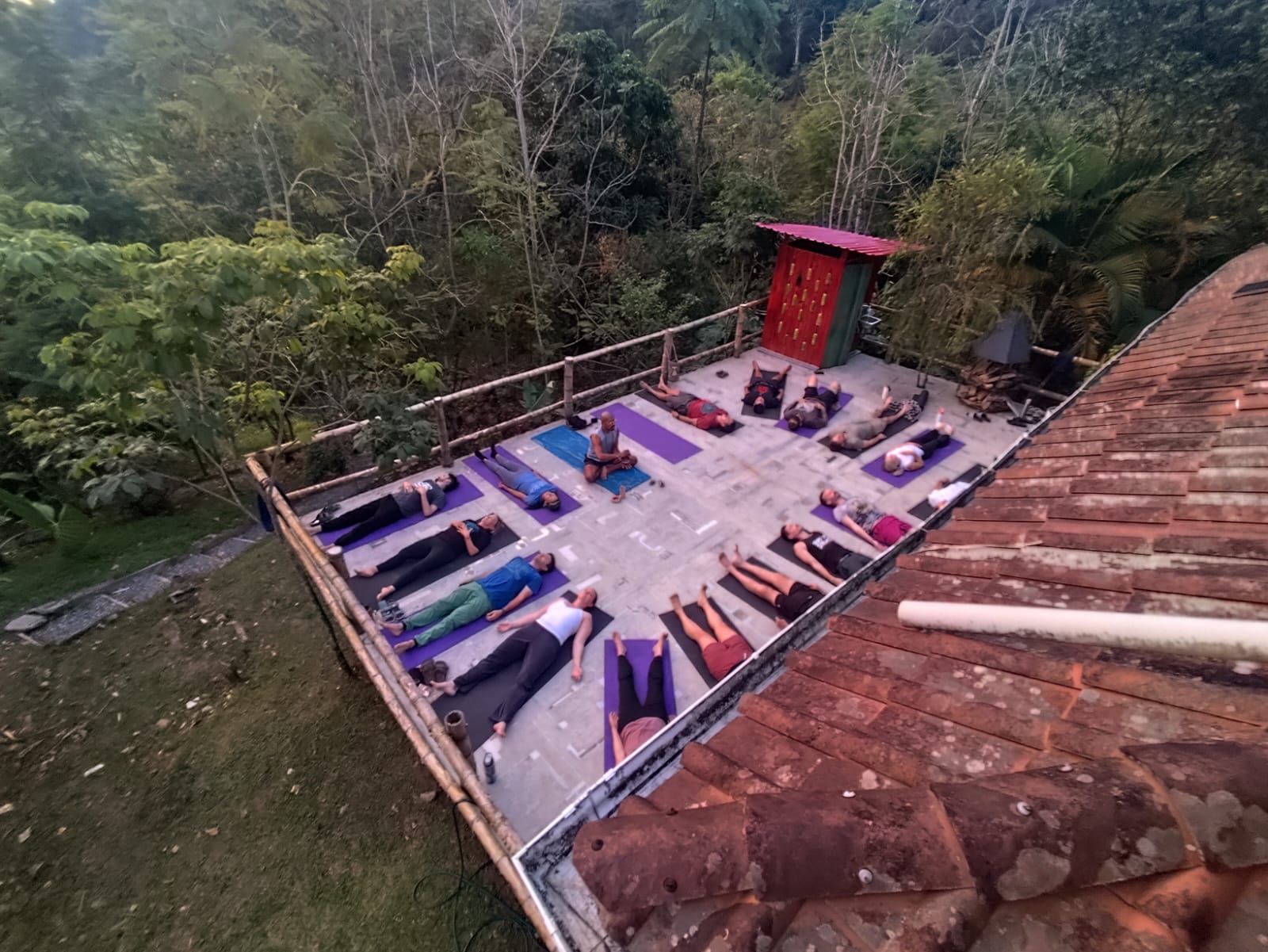
Recently, I had the privilege of attending a retreat hosted by Modern Spirit in the mountains outside Sasaima, Colombia. It brought together healthcare professionals from a variety of disciplines, all sharing a common desire: to work with experts in healing while also remaining students of it.
I arrived with questions I didn’t expect anyone to answer, but hoped to hold with greater honesty: questions about purpose, forgiveness, motherhood, love, and what it means to keep growing after years of doing my own work.
I left realizing that healing rarely gives us answers. Instead, it changes the way we hold our questions.
One of the first things I noticed in Colombia wasn’t the landscape, breathtaking as it was. It was the pace. Water flowed through the property from morning until night. Birds filled the trees before sunrise. Meals stretched into long conversations, and silence never felt uncomfortable.
Somewhere along the way, I realized how unfamiliar true stillness had become. Not because my life is chaotic, but because modern life quietly teaches us to measure our worth by our productivity.
And perhaps, without realizing it, we begin to make our lives more complicated than they need to be.
We accumulate responsibilities, expectations, possessions, plans, and ideas about who we’re supposed to become. We convince ourselves that the next accomplishment, the next project, the next answer will somehow bring us closer to peace.
But sitting in those mountains, I began to wonder whether peace might come from the opposite direction.
Maybe a meaningful life isn’t about continually adding more. Maybe part of healing is learning what we can gently put down.
The mountains offered a different invitation: to simplify. To notice, to breathe, to listen. To be present with the people we love. To remember that healing isn’t something we accomplish.
It’s something we allow.
During the retreat, I found myself continually noticing hummingbirds: one tattooed on a beautiful facilitator, others at the edge of the jungle, one appearing in a song, and still others showing up in unexpected moments throughout the week. The hummingbird came to feel like a reflection of something I was reconnecting within myself: a feminine energy that is light but powerful, tender but resilient, capable of great movement without losing its softness.
Unlike larger birds that command attention, hummingbirds invite us to slow down enough to notice them at all. They move with extraordinary precision while remaining remarkably light, and despite their size, they travel incredible distances.
I couldn’t help but wonder if healing asks something similar of us.
Not to become heavier with insight, but lighter.
To carry less and trust more. To distinguish between what is truly important and what we’ve simply become accustomed to carrying. To stay fully present with whatever flower is in front of us today instead of worrying about tomorrow’s garden.
Maybe simplifying our lives isn’t about having less for the sake of less. It’s about creating more room for what matters.
And increasingly, I believe what matters most is surprisingly simple: presence, connection, meaning, and love.
As the week unfolded, one theme surfaced again and again: motherhood, not simply the literal work of raising children, but something broader and deeper.
I began reflecting on how often healing begins with experiences we associate with good mothering: being seen without judgment, accepted without needing to perform, safe enough to soften, loved without having to earn it.
I thought about my children, my clients, and the countless moments over the years when someone simply needed another human being willing to sit beside them without trying to fix them. Perhaps that’s one of the greatest gifts we can offer each other: not solutions, but presence.
As therapists, we often speak about co-regulation. But beneath that clinical language is something beautifully human: sometimes people heal simply because someone stayed.
And perhaps beneath even that is something simpler still.
Love.
Not love as sentimentality or the absence of boundaries. Not love that asks us to tolerate harm or abandon ourselves. But the kind of love that allows another person to feel deeply seen while remaining fully themselves.
I have spent much of my career studying trauma and the many sophisticated ways we can help the nervous system heal. I believe deeply in that work. But Colombia reminded me of something that can become easy to overlook precisely because it sounds so simple: love itself can be healing.
Safe love. Consistent love. Love that doesn’t demand performance. Love that gives us enough security to tell the truth, enough belonging to soften our defenses, and enough courage to encounter the parts of ourselves we’ve kept hidden.
Sometimes healing happens through an intervention.
And sometimes healing happens because, in the presence of another human being, we finally experience what it feels like to be loved without needing to become someone else first.
One of my intentions for the week was simple: help me see my blind spots. It’s an easy thing to say and a much harder thing to truly mean.
Like many helping professionals, I spend a great deal of time reflecting on how I can improve: how to serve more effectively, communicate more clearly, become a better clinician, leader, wife, mother, friend.
What surprised me was realizing how often I overlook the good, how rarely I stop long enough to receive the love that already exists around me.
There was something humbling about recognizing that perhaps growth isn’t always asking more of ourselves.
Sometimes growth is allowing life to become simpler.
Sometimes it’s recognizing that enough is already here.
And sometimes it’s letting ourselves receive the love we’ve spent so much of our lives giving to everyone else.
Healing isn’t only about discovering where we’re wounded. It’s also about recognizing where we’ve already grown. Sometimes the blind spot isn’t our pain.It’s our own capacity to love and be loved.
Throughout the week, memories of different relationships surfaced: some bringing joy, others sadness, a few carrying wounds that had taken years to understand.
As I sat with them, something shifted. I found myself growing curious about the pain other people had carried long before our lives intersected. That curiosity didn’t erase accountability or rewrite history; it simply made room for compassion.
I’ve come to believe compassion and boundaries aren’t opposites. Healthy boundaries often become possible because compassion frees us from needing to stay emotionally entangled with the past.
And love doesn’t always mean staying.
Sometimes love looks like forgiveness. Sometimes it looks like a boundary. Sometimes it means allowing someone to walk their own path while we continue walking ours.
Healing doesn’t require us to pretend something didn’t hurt. It invites us to stop letting old pain decide who we become.Perhaps that, too, is a form of simplification: no longer carrying what was never ours to carry forever.
People often ask what happens during retreats like this. The honest answer is that no two people have the same experience; every journey is shaped by the person who arrives, their story, their hopes, their fears, their readiness.
What I can say is that meaningful healing rarely looks like dramatic transformation. More often it feels like remembering.
Remembering that softness and strength can coexist. That vulnerability isn’t weakness. That we’re worthy of the same compassion we so freely extend to others.
And perhaps remembering that life doesn’t have to be as complicated as we sometimes make it.
We spend so much time searching for the things that will finally make us feel whole. Yet some of the most powerful medicine available to us has been here all along: slowing down, being present, allowing ourselves to be known, loving others, and letting ourselves be loved.
I returned home not wanting to add more to my life, but wanting to become more intentional about what deserves to remain in it.Less noise. Less rushing. Less carrying what no longer belongs to me.
More presence.
More connection.
More love.
On the final day of the retreat, I came across a simple phrase:
La vida es un libro blanco, tú decides qué escribir.
Life is a blank book. You decide what to write.
Those words have stayed with me, not because they suggest our past doesn’t matter. It does. Every chapter, every joy, every heartbreak, every loss and relationship has shaped who we’ve become.
But healing offers us something extraordinary: while we cannot change the chapters behind us, we’re still entrusted with the pages ahead.
And perhaps we don’t need to fill every inch of them.
Perhaps there is wisdom in leaving some space.
Space to change our minds. Space to rest. Space for the people we love. Space for experiences we haven’t planned yet. Space simply to be.
For me, that may have been the greatest gift Colombia offered: not certainty, not perfection, not even answers.
Just the quiet reminder that I am still holding the pen.
Perhaps that’s what healing has always been: not becoming someone new, but gently setting down the stories that no longer define us, finding the courage to turn the page, and discovering that the blank space before us isn’t empty at all.
It’s room to breathe.Room to love.Room to live.
It’s possibility.
With deep gratitude to the team at Modern Spirit, whose thoughtful stewardship created a space for reflection, connection, and growth, and to every fellow participant whose openness and authenticity made the experience so meaningful.
Reach Out
We are here to support your healing journey with safe and compassionate care, helping you unlock new possibilities for growth and wellness.